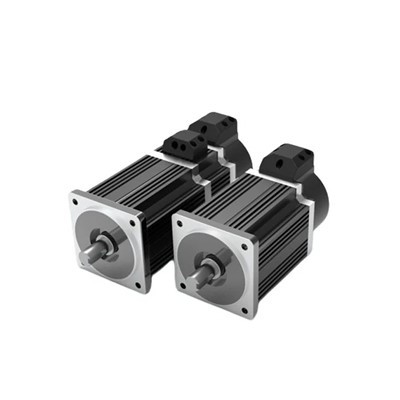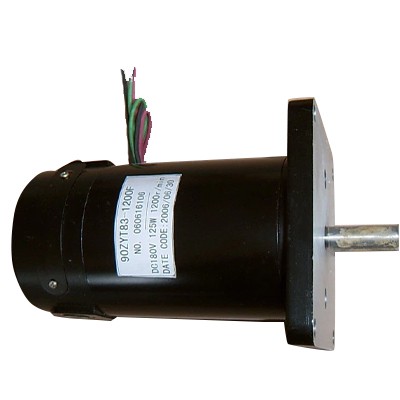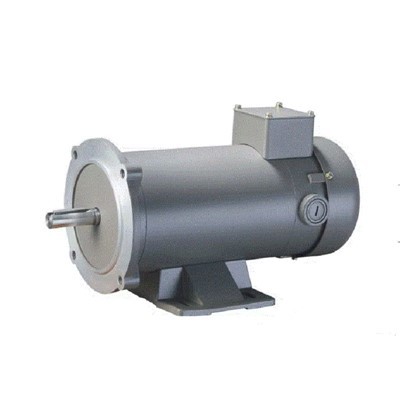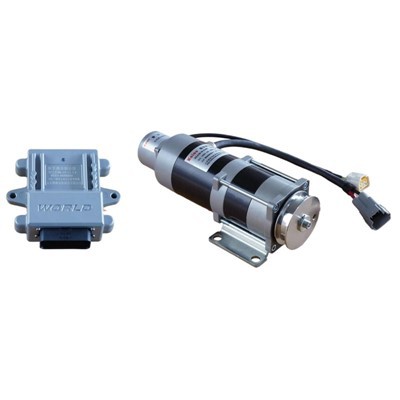
Choosing the right AGV drive motor is essential for reliable movement, efficient battery use, and long-term equipment performance. However, motor selection should not be based on payload or rated power alone. Wheel diameter, travel speed, acceleration, floor conditions, and gearbox ratio all influence the torque and power your AGV needs.
For AGV manufacturers, warehouse automation companies, and OEM equipment builders, selecting an appropriate motor can help avoid insufficient starting torque, excessive current draw, overheating, and unnecessary system costs.
In this guide, Auric explains how to calculate AGV motor requirements, compare 24V and 48V drive systems, select a suitable gearbox, and prepare specifications for an accurate motor quotation.
What Factors Determine the Right AGV Drive Motor?
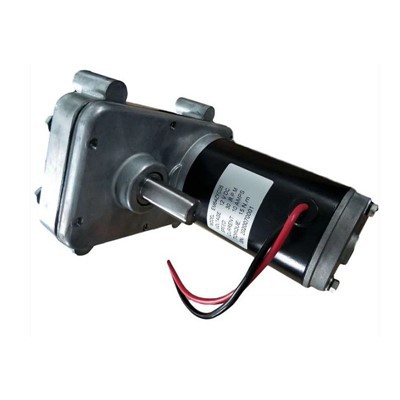
An Automated Guided Vehicle (AGV) uses an electric drive system to move loads along a defined route. Depending on the vehicle design, the drive system may include a DC motor, brushless DC motor, servo motor, gearbox, drive wheel, encoder, and motor controller.
Before selecting an AGV drive motor, consider six important factors.
|
Selection Factor |
What You Need to Know |
Impact on Motor Selection |
|---|---|---|
|
Total Vehicle Weight |
AGV weight + payload |
Determines rolling resistance and acceleration force |
|
Wheel Diameter |
Diameter of the driven wheels |
Affects wheel torque and rotational speed |
|
Travel Speed |
Required maximum operating speed |
Determines motor RPM and power |
|
Acceleration Time |
Time required to reach operating speed |
Affects peak torque demand |
|
Floor Conditions |
Smooth floor, rough surface, or incline |
Changes resistance and required driving force |
|
Drive Configuration |
Single drive, dual drive, or multiple drive wheels |
Determines how torque is distributed |
Important: The weight used for motor sizing is the total moving mass, not just the payload.
For example, an AGV carrying a 500 kg payload may have an additional 200 kg of vehicle weight. In this case, the calculation should begin with a total mass of 700 kg.
How Does AGV Payload Affect Motor Torque?
Payload directly affects the force needed to accelerate the vehicle, climb slopes, and overcome rolling resistance.
However, doubling the payload does not always mean doubling the required motor power. The relationship also depends on speed, wheel diameter, acceleration, and operating conditions.
Step 1: Calculate the total moving mass

For example:
AGV weight: 200 kg
Maximum payload: 500 kg
Total moving mass: 700 kg
Step 2: Calculate rolling resistance
For an AGV traveling on a level floor:

The AGV must generate at least this amount of horizontal force to overcome the assumed rolling resistance at steady speed on level ground, before accounting for other losses.
The actual rolling resistance coefficient depends on wheel material, floor quality, wheel bearings, and operating conditions. The value of 0.02 is an example, not a universal specification.
Step 3: Calculate acceleration force
If the AGV needs to reach 1.5 m/s in 3 seconds:

This simplified result excludes wheel rotational inertia, aerodynamic drag, turning resistance, and additional mechanical losses.
For final motor selection, these factors should be evaluated according to the actual AGV design.
How Does Wheel Diameter Affect AGV Motor Torque and Speed?
Wheel diameter is one of the most important parameters in AGV motor sizing.
A larger drive wheel travels farther per revolution, but it also requires more torque to generate the same tractive force.
A smaller wheel generally reduces the torque required at the wheel for the same driving force, but it must rotate faster to achieve the same vehicle speed.
The basic relationship is:

Using the previous example of 487.34 N total driving force:
|
Wheel Diameter |
Wheel Radius |
Total Required Wheel Torque |
|---|---|---|
|
100 mm |
0.05 m |
24.37 N·m |
|
150 mm |
0.075 m |
36.55 N·m |
|
200 mm |
0.10 m |
48.73 N·m |
|
250 mm |
0.125 m |
60.92 N·m |
Illustrative calculation for a total driving force of 487.34 N. Values represent combined wheel torque before drivetrain losses.
Wheel diameter vs. required wheel torque
Same driving force: 487.34 N

This demonstrates an important selection principle: increasing wheel diameter increases the required wheel torque for the same driving force.
However, wheel diameter should not be selected only to minimize motor torque. Larger wheels may offer advantages for ground clearance, obstacle negotiation, and uneven surfaces.
The final choice should balance wheel size, load capacity, vehicle speed, floor conditions, and available installation space.
How Do You Calculate AGV Motor RPM From Wheel Diameter and Speed?
The required wheel speed can be calculated from the vehicle's travel speed and wheel diameter.

For an AGV traveling at 1.5 m/s:
|
Wheel Diameter |
Required Wheel Speed |
|---|---|
|
100 mm |
286.5 RPM |
|
150 mm |
191.0 RPM |
|
200 mm |
143.2 RPM |
|
250 mm |
114.6 RPM |
These calculations assume the wheel rolls without slipping.
For a 200 mm drive wheel, approximately 143 RPM is needed to achieve a travel speed of 1.5 m/s.
If the motor operates at 3,000 RPM, the theoretical reduction ratio is:

A gearbox with a ratio close to 21:1 may therefore be worth evaluating.
However, the final gearbox ratio must also satisfy the motor's torque-speed capability, the required acceleration, and the transmission's efficiency and load limits.
How Much Motor Power Does an AGV Need?
AGV motor power depends on the driving force and travel speed.
The mechanical power delivered at the drive wheels is:

Using the earlier example:
Total driving force: 487.34 N
Vehicle speed: 1.5 m/s

The difference illustrates why AGV motor sizing must consider both continuous operation and acceleration requirements.
Example: Two-wheel drive AGV
Assume:
Total moving mass: 700 kg
Maximum speed: 1.5 m/s
Acceleration time: 3 seconds
Wheel diameter: 200 mm
Two powered drive wheels
Gearbox efficiency: 90%
The combined wheel torque required during acceleration is approximately 48.73 N·m.
If the load is shared equally:

Each motor must therefore deliver approximately 1.29 N·m during the calculated acceleration condition, before additional design allowances.
At approximately 3,000 RPM, this corresponds to about 405 W of mechanical output per motor.
These are theoretical sizing values, not an Auric product rating. The final design must also verify peak torque duration, RMS torque, motor and gearbox inertia, wheel traction, thermal limits, and drive current capacity.
Should You Choose a 24V, 48V, or 72V AGV Drive Motor?
Voltage selection should begin with the AGV's battery architecture and the power required by the drive system.
For the same electrical power, a higher voltage generally allows a lower current, which can reduce cable losses and ease some aspects of electrical distribution.
|
Comparison |
24V AGV Motor |
48V AGV Motor |
72V AGV Motor |
|---|---|---|---|
|
Power System |
24V-class battery |
48V-class battery |
72V-class battery |
|
Current at Equal Power |
Highest of the three |
Lower than 24V |
Lowest of the three |
|
Typical Consideration |
Existing low-voltage equipment |
Moderate to higher power mobile equipment |
Higher-voltage drive architectures |
|
Controller Requirement |
Compatible 24V-class drive |
Compatible 48V-class drive |
Compatible 72V-class drive |
|
Selection Priority |
Load, current, battery compatibility |
Load, current, battery compatibility |
Load, current, battery compatibility |
For example, at an electrical input of 1,200 W, the idealized current calculation is:
|
Nominal Voltage |
Calculated Current |
|---|---|
|
24V |
50A |
|
48V |
25A |
|
72V |
16.7A |
Actual current depends on the battery voltage under load, motor efficiency, controller efficiency, and transient operating conditions.
A 48V system can be attractive for many AGV applications, but it is not automatically the best option. Motor voltage should be selected alongside the battery, controller, required performance, wiring, and safety architecture.
Do AGVs Need a Gearbox?
Many AGV applications use a gearbox because the motor's efficient operating speed is significantly higher than the required wheel speed.
A gearbox reduces rotational speed and increases output torque, subject to transmission efficiency.
The gearbox selection should consider:
Reduction ratio: Matches motor speed to wheel speed.
Rated output torque: Must support the continuous operating load.
Peak torque capacity: Must accommodate acceleration and short-duration loads.
Efficiency: Affects the torque available at the wheel and the motor power required.
Backlash: May affect motion response and positioning behavior.
Mounting dimensions: Must fit the AGV chassis and drive assembly.
Service life: Depends on load cycles, lubrication, temperature, and operating conditions.
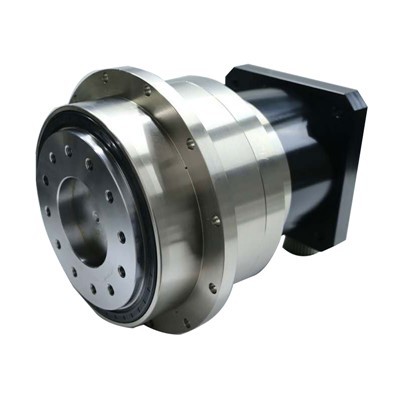
For compact AGVs, planetary gearboxes are one possible solution because they can provide substantial reduction within a relatively compact arrangement.
However, planetary gearboxes are not the only option. The most suitable transmission depends on the required ratio, torque, noise, space, cost, and maintenance requirements.
Brushed DC Motor vs. Brushless DC Motor vs. Servo Motor for AGVs
Different AGV designs require different levels of motion control, efficiency, and maintenance performance.
|
Feature |
Brushed DC Motor |
Brushless DC Motor |
Servo Motor System |
|---|---|---|---|
|
Commutation |
Mechanical |
Electronic |
Depends on motor design |
|
Speed Control |
Controller-dependent |
Controller-dependent |
Closed-loop speed control |
|
Position Control |
Requires suitable feedback and control |
Requires suitable feedback and control |
Commonly supported |
|
Maintenance |
Brush wear may require servicing |
No brush replacement |
Depends on motor and system |
|
System Complexity |
Can be relatively simple |
Requires electronic commutation |
Requires compatible feedback and servo control |
|
Suitable Use |
Applications where simplicity and cost are priorities |
AGVs requiring electronic control and reduced brush maintenance |
AGVs requiring tightly controlled motion |
A brushless DC motor can also operate as part of a servo system when combined with appropriate feedback and control electronics. Therefore, the categories are not always mutually exclusive.
For AGVs that require precise navigation, smooth acceleration, and repeatable stopping, evaluate the complete motor-drive-feedback system rather than the motor construction alone.
How Do You Choose an AGV Drive Motor for Different Payloads?
There is no universal rule that a 500 kg AGV requires a particular motor wattage or that a 1,000 kg AGV must use a specific motor size.
Two AGVs with the same payload may need different drive motors because their vehicle weight, wheel diameter, speed, acceleration, and operating surfaces differ.
The following table shows how the total required wheel torque changes with mass under the same illustrative conditions.
Assumptions: level floor, rolling resistance coefficient 0.02, acceleration of 0.5 m/s², and 200 mm wheel diameter. The values exclude rotational inertia, turning losses, and drivetrain losses.
|
Total Moving Mass |
Rolling Resistance |
Acceleration Force |
Total Wheel Torque |
|---|---|---|---|
|
300 kg |
58.9 N |
150 N |
20.9 N·m |
|
500 kg |
98.1 N |
250 N |
34.8 N·m |
|
700 kg |
137.3 N |
350 N |
48.7 N·m |
|
1,000 kg |
196.2 N |
500 N |
69.6 N·m |
|
1,500 kg |
294.3 N |
750 N |
104.4 N·m |
AGV mass vs. combined wheel torque
Under identical wheel and acceleration assumptions

The practical lesson is that payload is only the starting point. A proper motor recommendation requires the full operating profile.
What Common Mistakes Should AGV Manufacturers Avoid?
Mistake 1: Selecting a motor based only on rated power
Rated power does not tell you whether the motor can generate enough torque during acceleration or operate efficiently at the required wheel speed.
Better approach: Compare continuous torque, peak torque, speed range, and thermal performance.
Mistake 2: Ignoring the AGV's own weight
Calculating the motor based only on the payload underestimates the total moving mass.
Better approach: Use the maximum loaded vehicle weight.
Mistake 3: Choosing a larger wheel without recalculating torque
Increasing wheel diameter changes both wheel torque and rotational speed requirements.
Better approach: Recalculate the drive system whenever the wheel diameter changes.
Mistake 4: Ignoring slopes and uneven floors
A motor sized only for smooth, level warehouse floors may be unsuitable for ramps or rough surfaces.
Better approach: Include the maximum slope, floor conditions, and required starting performance.
Mistake 5: Ignoring gearbox efficiency and mechanical losses
Not all motor output torque reaches the wheel.
Better approach: Include realistic drivetrain efficiency and verify gearbox ratings.
Mistake 6: Overlooking traction limits
Even a motor with sufficient torque may cause wheel slip if the driven wheels do not have enough normal force or friction.
Better approach: Verify wheel loading, tire material, floor friction, and maximum available traction.
Mistake 7: Choosing the cheapest motor without checking system compatibility
A low-cost motor can increase total equipment cost if it requires changes to the controller, mounting structure, gearbox, or wiring.
Better approach: Compare the total cost of the motor-drive system, including integration and maintenance.
What Should You Look for in an AGV Drive Motor Manufacturer?
For OEM buyers, a suitable AGV motor manufacturer should be able to help verify the motor configuration against the actual vehicle requirements.
Before selecting a supplier, evaluate the following.
Motor selection support
Can the supplier assess your vehicle mass, wheel size, speed, and acceleration requirements rather than recommending a motor based only on power?
Electrical compatibility
Can the supplier confirm the operating voltage range, current demand, feedback interface, and controller requirements?
Mechanical customization
Can the available motor configuration accommodate your shaft, mounting, gearbox, connector, and installation requirements?
Performance documentation
Can the supplier provide the relevant dimensional drawings, torque-speed curves, and operating limits?
Quality and consistency
Are inspection criteria, testing requirements, and acceptance standards clearly defined before production?
OEM supply planning
Can the supplier clarify sample availability, production lead time, minimum order quantity, and support for repeat orders?
Auric offers motor solutions for industrial equipment applications, including AGV-related drive requirements. Buyers can submit their operating parameters for configuration evaluation and quotation.
When comparing AGV drive motor suppliers, request quotations based on the same technical specifications so that price differences can be assessed fairly.
What Information Should You Send to Auric for an AGV Motor Quote?
To obtain a more accurate recommendation and quotation, prepare the following information.
|
Required Information |
Example |
|---|---|
|
AGV Type |
Warehouse AGV / AMR / Transfer Robot |
|
Vehicle Weight |
200 kg |
|
Maximum Payload |
500 kg |
|
Total Moving Mass |
700 kg |
|
Maximum Travel Speed |
1.5 m/s |
|
Acceleration Time |
3 seconds |
|
Wheel Diameter |
200 mm |
|
Number of Drive Wheels |
2 |
|
Maximum Slope |
Specify angle or gradient |
|
Battery Voltage |
24V / 48V / 72V |
|
Operating Duty |
Hours per day, starts per hour, load cycle |
|
Control Requirements |
Speed / Torque / Position |
|
Order Quantity |
Prototype / Trial Order / Mass Production |
The example values above are for illustration only.
For an existing AGV design, sending the current motor nameplate, dimensional drawing, gearbox information, and controller specifications can help the supplier evaluate replacement compatibility.
Frequently Asked Questions About AGV Drive Motors
Q1. How much motor power does a 500 kg AGV need?
There is no fixed wattage based on payload alone. You must include the AGV's own weight, required speed, acceleration, wheel diameter, floor resistance, slope, and drivetrain efficiency. Calculate the continuous and peak requirements before selecting a motor.
Q2. Is a 48V motor better than a 24V motor for an AGV?
A 48V system generally draws less current than a 24V system at the same electrical power, which can reduce resistive losses. However, the correct voltage depends on the battery, motor design, controller, and overall power requirements.
Q3. Does a larger AGV wheel require more motor torque?
For the same tractive force, a larger wheel requires more torque at the wheel because the radius is greater. It also requires fewer revolutions to achieve the same travel speed.
Q4. Can an AGV use a brushed DC motor?
Yes. A brushed DC motor can be used when its performance, control, and maintenance characteristics suit the application. For applications with demanding duty cycles or maintenance requirements, brushless configurations may be worth comparing.
Q5. How do I calculate the gearbox ratio for an AGV?
Divide the motor's operating speed by the required wheel speed. Then verify that the resulting ratio allows the motor to deliver the required continuous and peak torque without exceeding its speed, current, or thermal limits.
Q6. What is the difference between an AGV drive motor and an AGV steering motor?
A drive motor provides propulsion, while a steering motor changes the orientation of a steering mechanism or wheel assembly. Some AGV configurations combine driving and steering functions within a single drive module.
Q7. Can Auric provide motors for customized AGV projects?
Customization possibilities depend on the required electrical, mechanical, and performance specifications. Contact Auric with your AGV design parameters to discuss available motor configurations and project requirements.
Q8. What is the most important parameter when selecting an AGV drive motor?
There is no single parameter that determines the correct choice. The most important task is to establish the complete load and motion profile, then verify the motor's torque-speed performance, thermal capacity, electrical compatibility, and mechanical integration.
Conclusion: Select Your AGV Motor Based on Real Operating Conditions
Choosing the right AGV drive motor starts with understanding the vehicle, not choosing a motor from a catalog.
Payload determines part of the required driving force. Wheel diameter affects torque and rotational speed. Acceleration, slopes, floor conditions, and gearbox efficiency further influence the motor's continuous and peak performance requirements.
For AGV manufacturers and industrial buyers, a properly matched drive system can improve motion reliability, simplify integration, and reduce the risk of premature motor or gearbox failure.
Auric provides motor solutions for industrial equipment and AGV applications.
Whether you are developing a new AGV, upgrading an existing drive system, or sourcing motors for OEM production, send us your vehicle weight, payload, wheel diameter, travel speed, battery voltage, and required quantity.
Our team can review your specifications and discuss suitable motor configurations, customization requirements, and quotation options.