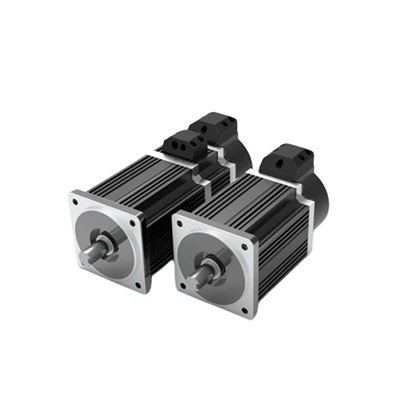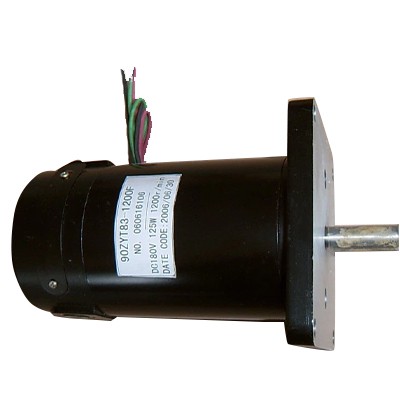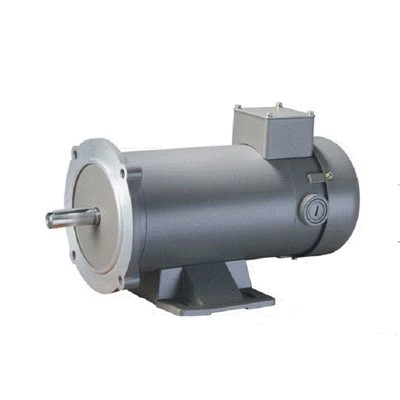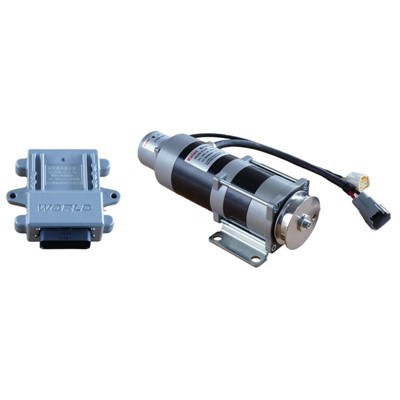
Choosing a servo motor based only on motor power is one of the easiest ways to make a poor selection.
A machine may be labeled as requiring a 750 W, 1 kW, or 2 kW servo motor, but power alone does not tell you whether the motor can actually accelerate the load, maintain speed, or stop accurately.
The more useful question is:
How much torque does the application really require?
For a servo motor, torque determines whether the motor can move the load, accelerate it within the required time, and handle changes in operating conditions without overload.
This guide explains a practical way to calculate servo motor torque requirements before selecting a motor. It also covers several factors that are often overlooked, including load inertia, peak torque, transmission efficiency, vertical loads, acceleration time, and duty cycle.


Why Servo Motor Torque Is More Important Than Power Alone
Motor power and torque are related, but they describe different aspects of motor performance.
Power tells you how much mechanical work the motor can deliver over time.
Torque tells you how much rotational force the motor can produce.
A machine that needs high torque at relatively low speed may require a very different motor from a machine that needs high speed with a relatively small load.
For example, consider two machines:
Machine A
Required torque: 10 N·m
Operating speed: 500 RPM
Machine B
Required torque: 10 N·m
Operating speed: 3,000 RPM
The torque requirement is identical, but Machine B requires much more mechanical power because it operates at a much higher speed.
This is why servo motor selection should start with the actual motion requirements rather than simply choosing a motor based on wattage.
The Basic Servo Motor Torque Calculation
The simplest torque relationship is:
In a real industrial machine, however, the required motor torque is rarely just the torque created by the load.
A more practical calculation considers several components:
Required Motor Torque = Load Torque + Acceleration Torque + Friction Torque + Gravity Torque + Transmission Losses
Not every application requires all of these terms.
For example, a horizontal conveyor may have significant friction and acceleration torque but relatively little gravity-related torque.
A vertical lifting axis, on the other hand, may have a substantial gravity torque component.
Step 1: Identify What the Motor Is Actually Moving
Before calculating torque, identify the complete mechanical load connected to the motor.
This may include:
- Conveyor belt
- Roller
- Pulley
- Screw
- Gear
- Rotary table
- Robot arm
- Fan
- Pump
- Cutting tool
- Material being transported
Do not calculate the torque based only on the product weight.
The motor may also need to accelerate the mechanical components themselves.
For example, a conveyor system may be moving a 50 kg product, but the motor may also need to accelerate the belt, rollers, pulleys, and other rotating components.
Step 2: Calculate the Load Torque
For a simple rotating load, the required torque depends on the force acting on the system and the effective radius.
For example, if a pulley needs to generate a certain tangential force, the required torque increases as the pulley radius increases.
This is an important point when selecting a motor.
A relatively small force applied through a large radius can require considerable torque.
When calculating the load, identify:
- Required linear force
- Pulley or drum diameter
- Screw lead
- Gear ratio
- Mechanical efficiency
The actual mechanical configuration often has a bigger effect on torque requirements than the motor power rating suggests.
Step 3: Calculate Acceleration Torque
This is one of the most commonly overlooked parts of servo motor sizing.
A servo motor does not only need to keep the load moving.
It also needs to change the load's speed.
The faster the required acceleration, the greater the acceleration torque.
Acceleration torque is related to:
- Load inertia
- Motor inertia
- Required acceleration
- Gear ratio
For a rotating system, acceleration torque can be represented conceptually as:
Acceleration Torque = Total Inertia × Angular Acceleration
This is why a large rotary table may require a much larger servo motor than its steady-state load would suggest.
The machine may only require modest torque while rotating at a constant speed, but a large amount of torque may be required to accelerate the table from zero to operating speed.
Why Acceleration Time Matters
Consider two machines that both need to reach 2,000 RPM.
Machine A
Acceleration time: 5 seconds
Machine B
Acceleration time: 0.5 seconds
The second machine needs to reach the same speed ten times faster.
Assuming the load and other conditions remain the same, the required acceleration torque can be substantially higher.
This is why suppliers need to know not only the maximum speed, but also:
- Starting speed
- Target speed
- Acceleration time
- Deceleration time
For high-speed automation, acceleration requirements can become the deciding factor in motor selection.
Step 4: Consider Friction Torque
Real mechanical systems always have some degree of friction.
Sources may include:
- Bearings
- Seals
- Gearboxes
- Belts
- Linear guides
- Chains
- Screw mechanisms
Friction may be relatively small in a well-designed machine, but it should not be ignored.
Friction can also increase as components wear or lubrication conditions change.
For critical industrial applications, the calculation should consider the expected worst-case friction rather than only the ideal condition of a new machine.
Step 5: Calculate Gravity Torque for Vertical Applications
Vertical motion requires special attention.
When a servo motor lifts a load, the motor must work against gravity.
This means a vertical axis may require significant torque even when it is moving slowly.
Typical examples include:
- Z-axis systems
- Lifting platforms
- Hoists
- Robotic vertical joints
- Automated storage systems
- Vertical conveyors
For these applications, calculate the torque required to hold and move the load.
You should also determine whether the system requires a holding brake.
A brake can help prevent unwanted movement when power is removed, but the complete machine safety design should determine how the load is safely held.
Step 6: Include Mechanical Transmission Efficiency
Very few servo motors connect directly to the load.
Most industrial systems use some form of transmission:
- Gearbox
- Belt
- Pulley
- Chain
- Ball screw
- Planetary gearbox
- Harmonic drive
Every transmission introduces some mechanical loss.
For example, if the transmission efficiency is 90%, the motor needs to produce more torque than the load itself requires.
Ignoring transmission losses can result in a motor that looks adequate on paper but struggles during real operation.
Step 7: Understand the Effect of Gear Ratio
A gearbox can significantly change the torque and speed requirements seen by the motor.
Suppose the machine requires high output torque at relatively low speed.
A gearbox can reduce motor speed while increasing output torque.
This can allow a smaller, higher-speed servo motor to drive a much heavier load.
However, the gearbox also introduces:
- Efficiency losses
- Backlash
- Additional inertia
- Mechanical complexity
- Additional cost
For precision applications, gearbox backlash should be included when evaluating final positioning performance.
Continuous Torque vs Peak Torque
After calculating the basic torque requirement, you need to distinguish between continuous torque and peak torque.
This is essential for servo motor selection.
Continuous Torque
Continuous torque is the torque required during normal operation.
For example, a conveyor may continuously require 4 N·m while running at its normal production speed.
The selected motor should be capable of delivering this torque without excessive temperature rise.
Peak Torque
Peak torque is required for short periods.
- Examples include:
- Rapid acceleration
- Rapid deceleration
- Starting a heavy load
- Sudden load changes
- Frequent reversing
- A machine may therefore have:
- Continuous torque requirement: 4 N·m
- Peak torque requirement: 9 N·m
In this case, selecting a motor based only on the 4 N·m continuous requirement could be a mistake.
The motor and drive must also be capable of handling the 9 N·m peak requirement for the required duration.
Do Not Select a Servo Motor Based on Average Torque
Average torque can be useful for understanding the overall operating cycle, but it does not tell the complete story.
Imagine a machine with the following cycle:
- Accelerate rapidly
- Run at constant speed
- Decelerate rapidly
- Stop
- Reverse
- Repeat
- The average torque might look reasonable.
However, the motor could still experience overload during acceleration or deceleration.
For servo motor selection, the worst operating point should be identified first.
Then evaluate the complete duty cycle and thermal requirements.


How Load Inertia Changes Servo Motor Torque Requirements
Load inertia is one of the most important factors in servo sizing.
A heavy object does not necessarily have high rotational inertia.
What matters is how the mass is distributed relative to the axis of rotation.
A large roller with much of its mass near the outside diameter can have significantly more inertia than a compact component with the same mass.
High inertia can lead to:
- Higher acceleration torque
- Longer settling time
- Overshoot
- Vibration
- Positioning problems
For applications involving large rotating components, inertia should be calculated rather than estimated simply from weight.
What About Servo Motor Torque at High Speed?
A common mistake is assuming that the motor's rated torque remains available at every speed.
It does not necessarily work that way.
Servo motors have torque-speed characteristics.
As operating speed increases, available torque may eventually decrease.
Therefore, you should check:
Continuous torque at operating speed
Peak torque at operating speed
Maximum speed
Required acceleration at operating speed
For example, if your application requires 8 N·m at 3,000 RPM, it is not enough to know that the motor has an 8 N·m rated torque.
You need to confirm that the motor can actually provide the required torque at 3,000 RPM.
How to Avoid Oversizing the Servo Motor
Some buyers intentionally choose a much larger motor because they believe "more torque is safer."
That approach can create new problems.
An oversized servo motor can result in:
- Higher motor cost
- Larger servo drive
- Higher system inertia
- Larger physical dimensions
- Increased energy consumption
- More difficult mechanical integration
A larger motor is only useful if the machine can actually benefit from its additional capacity.
The objective should be to provide sufficient torque and reasonable reserve capacity-not maximum possible torque.
How to Avoid Undersizing the Servo Motor
Undersizing is usually more problematic.
A motor operating too close to its limits may experience:
- Overload alarms
- Excessive temperature
- Poor acceleration
- Reduced service life
- Positioning instability
The motor should be evaluated against the worst expected operating condition.
Pay particular attention to:
- Maximum load
- Maximum acceleration
- Maximum speed
- High-friction conditions
- Frequent reversing
- Long operating cycles
A Practical Servo Motor Torque Calculation Example
Let's consider a simplified rotary application.
The machine requires:
- Continuous load torque: 5 N·m
- Acceleration torque: 3 N·m
- Friction torque: 1 N·m
- Transmission efficiency: 90%
The approximate torque before considering other design factors would be the sum of the load, acceleration, and friction requirements, adjusted for transmission losses.
The important lesson is not the final number.
The important lesson is that the motor's required torque is rarely equal to the load torque alone.
If you only calculate the steady-state load, you may underestimate the motor size required for acceleration.
For an actual machine, the calculation should be performed using the complete motion profile and the worst expected conditions.
How to Select the Servo Motor After Calculating Torque
Once the torque requirement has been calculated, do not immediately select the motor.
You should compare the calculated requirement against the motor's:
- Continuous torque
- Peak torque
- Rated speed
- Maximum speed
- Torque-speed curve
- Rotor inertia
- Encoder
- Drive compatibility
- Thermal characteristics
The motor should satisfy both the mechanical and electrical requirements.
A motor with sufficient torque but insufficient speed is not suitable.
A motor with sufficient speed but inadequate peak torque is also not suitable.
Torque Is Only One Part of Servo Motor Selection
Although torque is critical, it should not be evaluated independently.
You should also consider:
Speed
Can the motor provide the required torque at the required RPM?
Accuracy
Can the complete system achieve the required positioning accuracy and repeatability?
Inertia
Can the motor control the connected load effectively?
Duty Cycle
Can the motor handle the actual acceleration, deceleration, and operating cycle without excessive heating?
Environment
Can the motor operate reliably under the actual temperature, dust, humidity, and vibration conditions?
These factors determine whether the motor will perform reliably after installation.
When Should You Consider a High Torque Servo Motor?
A high torque servo motor may be appropriate for applications involving:
- Heavy loads
- Large rotary tables
- High-inertia mechanisms
- Vertical lifting
- Rapid acceleration
- Frequent reversing
- Heavy-duty robotics
- Material handling equipment
However, high torque does not automatically mean better performance.
The motor should be selected according to the actual load and motion profile.
What Information Should You Give Your Servo Motor Supplier?
If you want an accurate motor recommendation, provide more information than just "I need a 2 kW servo motor."
Ideally, provide:
Mechanical Information
- Load weight
- Load inertia
- Pulley diameter
- Screw lead
- Gear ratio
- Transmission type
- Mechanical efficiency
Motion Requirements
- Continuous speed
- Maximum speed
- Acceleration time
- Deceleration time
- Cycle time
- Reversing frequency
Torque Requirements
- Continuous load torque
- Peak load torque
- Holding torque
- Starting torque
Electrical Requirements
- Available voltage
- Controller
- Servo drive
- Encoder requirements
Environment
- Ambient temperature
- Dust
- Humidity
- Vibration
- Installation conditions
The more complete the information, the more accurately the motor can be selected.
How Auric Helps With Servo Motor Selection
For OEM manufacturers, calculating servo motor torque is only the first step.
The final motor needs to fit the machine's mechanical structure, electrical architecture, control system, and production cycle.
Auric provides servo motor solutions for industrial automation, OEM machinery, robotics, material handling, packaging equipment, and other motion control applications.
Instead of selecting a motor based only on rated power, Auric can evaluate application requirements such as:
- Continuous torque
- Peak torque
- Operating speed
- Acceleration
- Load inertia
- Duty cycle
- Encoder configuration
- Motor voltage
- Mounting dimensions
- Shaft configuration
- Brake requirements
- Servo drive compatibility
For OEM applications, customized motor configurations can also be considered when a standard catalog motor does not fit the machine.
This application-based approach helps reduce the risk of selecting a motor that is either undersized or unnecessarily oversized.
Servo Motor Torque Calculation Checklist
Before selecting your motor, make sure you know:
- Continuous load torque
- Peak load torque
- Acceleration torque
- Friction torque
- Gravity torque, if applicable
- Load inertia
- Gear ratio
- Transmission efficiency
- Normal operating speed
- Maximum speed
- Acceleration time
- Deceleration time
- Duty cycle
- Required positioning accuracy
- Available power supply
If several of these values are unknown, it is better to work with the motor supplier before placing an order rather than selecting a motor based on power alone.
Frequently Asked Questions

Final Thoughts
Calculating servo motor torque requirements is not simply a matter of looking at the weight of the load.
A reliable calculation needs to consider the entire motion system:
Load + Acceleration + Friction + Gravity + Transmission + Inertia + Duty Cycle
The motor also needs to provide the required torque at the required speed, not just meet a torque rating listed on a catalog page.
For this reason, the best servo motor selection process starts with the machine's real operating conditions.
Calculate the continuous torque.
Calculate the peak torque.
Check acceleration.
Evaluate load inertia.
Consider transmission losses.
Then compare these requirements with the motor's torque-speed characteristics and drive compatibility.
For industrial OEMs, providing these details to a professional supplier such as Auric can make motor selection much more accurate and help avoid the two most common problems in servo applications: choosing a motor that is too small or paying for one that is unnecessarily large.