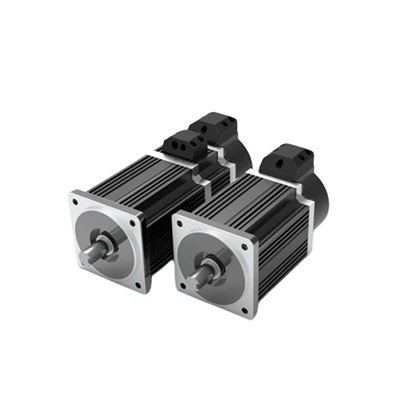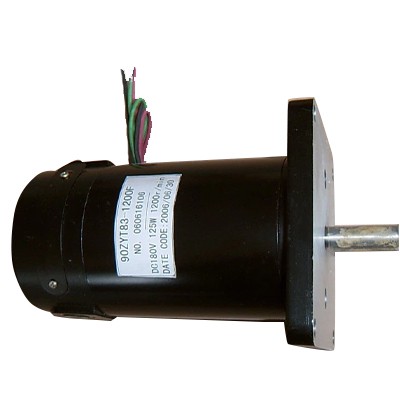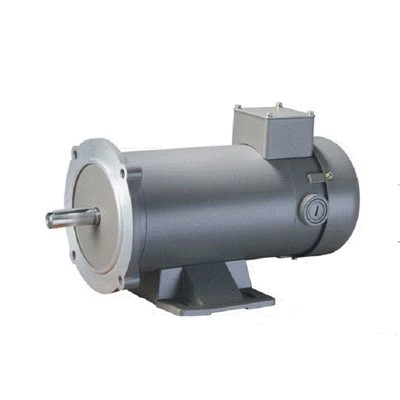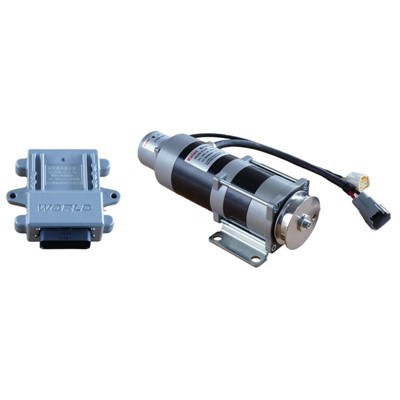
Servo motors are one of the most important components in modern automation systems. They are widely used in CNC machines, robotics, packaging equipment, and precision manufacturing because they provide accurate control of position, speed, and torque.
However, when engineers or manufacturers choose a servo motor, they often encounter several different types, such as AC servo motors, DC servo motors, and brushless servo motors. Each type offers different advantages in terms of efficiency, performance, and maintenance.
Understanding the differences between these servo motor technologies can help manufacturers select the best solution for their automation equipment.

What Is a Servo Motor?
A servo motor is a motor used in a closed-loop control system that continuously monitors and adjusts its position, speed, and torque. It works together with a controller and a feedback device such as an encoder to maintain precise motion control.
Unlike ordinary electric motors that simply rotate when powered, a servo motor constantly compares its actual position with the target command and corrects any deviation automatically. This feedback mechanism is what allows servo systems to achieve extremely high accuracy.
Because of this capability, industrial servo motors are commonly used in:
CNC machining centers
Robotics systems
Packaging machines
Textile equipment
Semiconductor manufacturing
AC Servo Motor vs DC Servo Motor vs Brushless Servo Motor
Different servo motors use different electrical designs and control methods. The most common types include AC servo motors, DC servo motors, and brushless servo motors.
| Feature | AC Servo Motor | DC Servo Motor | Brushless Servo Motor |
|---|---|---|---|
| Power supply | AC power | DC power | Usually DC with electronic commutation |
| Efficiency | High | Moderate | Very high |
| Maintenance | Low | Higher (brush wear) | Very low |
| Speed range | Wide | Moderate | Wide |
| Industrial use | Very common | Limited today | Increasing rapidly |
Each of these motor types serves different automation requirements.
AC Servo Motors: The Standard for Industrial Automation
AC servo motors are currently the most widely used servo motors in industrial machinery.
Advantages
AC servo motors offer several important benefits:
High efficiency and stable performance
Excellent speed and torque control
Low maintenance due to brushless design
Suitable for high-power applications
Most modern CNC equipment, robotics, and industrial automation systems use AC permanent-magnet servo motors, which provide strong torque and high responsiveness.
Typical Applications
AC servo motors are commonly used in:
CNC machine tools
Industrial robots
Packaging machinery
Automated assembly lines
These applications require high-speed response and precise positioning.
DC Servo Motors: Simple and Cost-Effective
DC servo motors were widely used in earlier automation systems and are still found in some applications.
Advantages
DC servo motors are valued for:
Simple control systems
Lower initial cost
Good low-speed performance
However, traditional DC motors often include brushes, which can wear over time and require maintenance.
Typical Applications
DC servo motors are often used in:
Small automation equipment
Educational robotics systems
Light-duty positioning devices
While they remain useful in some scenarios, they are gradually being replaced by brushless servo motors.
Brushless Servo Motors: High Efficiency and Reliability
Brushless servo motors are becoming increasingly popular in modern automation systems.
Instead of mechanical brushes, these motors use electronic commutation to control current flow, which reduces friction and improves efficiency.
Advantages
Brushless servo motors provide several benefits:
Longer service life
Higher efficiency
Reduced maintenance
Improved reliability
Because of these advantages, brushless servo motors are widely used in high-precision industrial systems.
Typical Applications
Common applications include:
Industrial robots
Semiconductor manufacturing equipment
Medical automation systems
High-speed production lines


How to Choose the Right Servo Motor
Selecting the correct servo motor depends on several important factors.
Torque and speed requirements
Different machines require different torque levels and rotational speeds.
Precision requirements
Applications such as CNC machining or robotics require extremely precise motion control.Environmental conditions
Temperature, humidity, and dust levels can affect motor performance and lifespan.
System compatibility
Servo motors must work with compatible drives and controllers to ensure stable operation.
Servo motors play a critical role in modern industrial automation. Among the different options available:
AC servo motors are the standard solution for most industrial equipment.
DC servo motors provide a simple and cost-effective option for smaller systems.
Brushless servo motors offer high efficiency and long service life for advanced applications.
Choosing the right servo motor depends on the performance requirements, control system design, and application environment of the machinery.

If you are looking for reliable industrial servo motor solutions for automation equipment, CNC machinery, or robotics systems, Auric Motor offers high-performance servo motors designed for precision motion control and long-term reliability.
Contact our technical team today to find the right servo motor for your application.