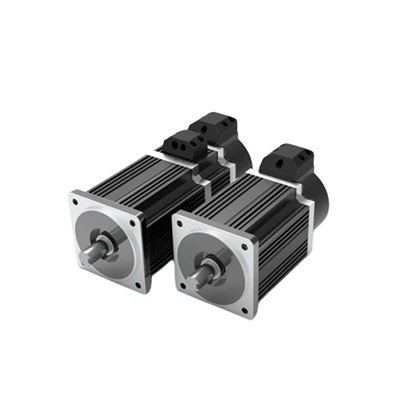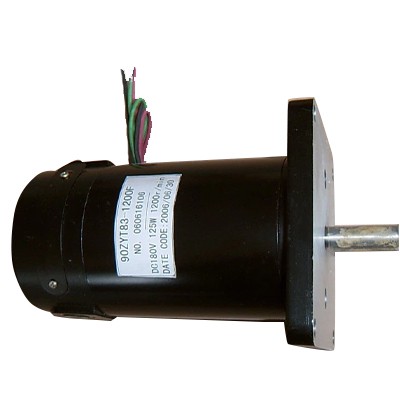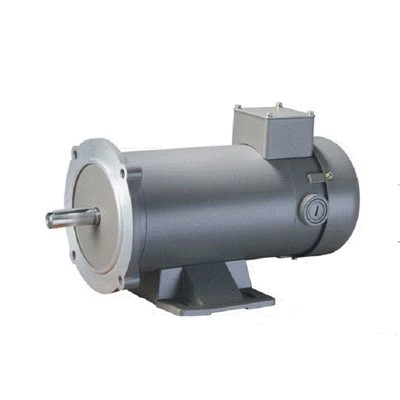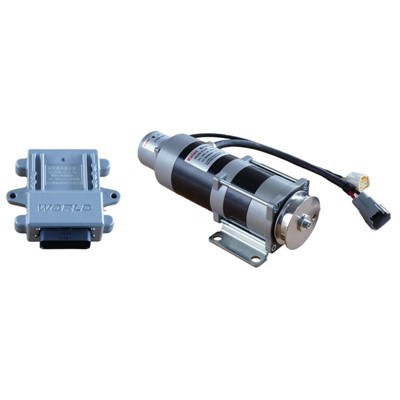
In motion control systems, engineers often face a common decision: whether to use a DC gearmotor or a stepper motor. Both technologies are widely used in automation equipment, robotics, medical devices, and small industrial machines. However, they operate based on very different principles and are optimized for different types of applications.
Choosing the wrong motor can lead to inefficient performance, excessive power consumption, unstable motion, or unnecessary system cost. Understanding the differences between these two motor technologies is therefore essential when designing or purchasing motion control components.
This article examines the key differences between DC gearmotors and stepper motors, focusing on performance characteristics, control requirements, torque behavior, efficiency, and real-world applications.

Understanding How a DC Gearmotor Works
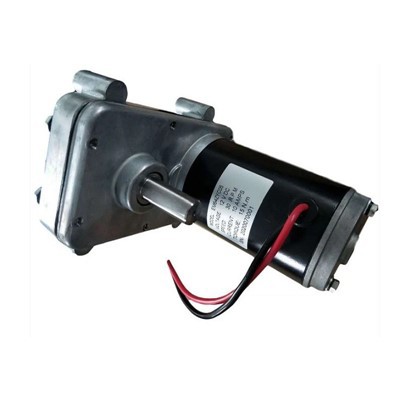
A DC gearmotor combines a standard DC motor with a mechanical gearbox. The gearbox reduces the motor speed while increasing the output torque. This combination allows the motor to drive loads that would otherwise require a much larger motor.
The DC motor produces rotational motion, while the gear reduction stage converts that motion into slower and more powerful output. Gear trains such as planetary gears, spur gears, or worm gears are commonly used depending on the application.
Because the gearbox multiplies torque, a compact DC motor can drive relatively heavy mechanical loads while maintaining stable speed.
Speed control is usually achieved by adjusting the supply voltage or using PWM motor controllers. This makes DC gearmotors relatively easy to integrate into many systems.
Understanding How a Stepper Motor Works
A stepper motor operates using a completely different control concept. Instead of rotating continuously when voltage is applied, a stepper motor moves in discrete angular steps.
Each electrical pulse sent by the controller moves the rotor by a fixed step angle. By controlling the number of pulses and their frequency, the system can precisely control position and speed.
Stepper motors are commonly used in open-loop positioning systems where accurate incremental motion is required without the need for complex feedback devices.
Because of their stepping behavior, stepper motors are often used in equipment where precise positioning is more important than high torque efficiency.
Torque Characteristics: Continuous Power vs Holding Force
One of the most important differences between DC gearmotors and stepper motors is how they generate torque.
A DC gearmotor provides continuous rotational torque. The gearbox multiplies the motor torque, allowing the output shaft to move heavy loads smoothly. Even under varying load conditions, the motor can maintain rotation with relatively stable efficiency.
Stepper motors behave differently. They produce high holding torque when stationary, which allows them to maintain a fixed position without movement. However, their torque decreases rapidly as speed increases.
In practical applications, this means stepper motors perform well at low speeds but may struggle to deliver sufficient torque at higher speeds.
DC gearmotors, by contrast, typically maintain more consistent torque across a wider speed range.

Motion Smoothness and Noise
Another difference appears in motion smoothness.
Because stepper motors move in discrete increments, they can produce small vibrations during operation. In some systems this stepping behavior can generate audible noise or mechanical resonance.
Modern microstepping drivers can reduce this effect, but the fundamental stepping nature still exists.
DC gearmotors rotate continuously, producing smoother motion. The gearbox also dampens vibration, which can result in quieter operation.
For applications such as medical equipment, mobility systems, or consumer devices where smooth motion is important, DC gearmotors are often preferred.
Control Complexity
Stepper motors require specialized drivers that generate pulse signals to control motion. The control system must precisely manage step timing and current regulation.
Although stepper control is widely understood, the electronics and software required are more complex than simple DC motor control.
DC gearmotors, on the other hand, can be controlled with relatively simple circuits. Speed can be adjusted by varying voltage or by using a PWM controller.
This simplicity is one reason DC gearmotors are commonly used in cost-sensitive equipment.
Efficiency and Power Consumption
Efficiency is another area where the two technologies differ significantly.
Stepper motors consume current continuously even when holding position. In applications where the motor remains stationary for long periods, this can lead to unnecessary power consumption and heat generation.
DC gearmotors typically draw current proportional to load. When the load is light, the motor consumes less energy.
As a result, DC gearmotors are often more energy-efficient in applications that involve continuous rotation or varying loads.
Cost Considerations
From a system cost perspective, DC gearmotors are often more economical.
The motor itself is relatively simple, and the control electronics can be inexpensive. When paired with a suitable gearbox, the system can deliver strong torque at a reasonable cost.
Stepper motors may require more advanced drivers and higher current electronics. In addition, achieving high torque often requires larger motor frames.
For equipment manufacturers producing high volumes of machines, these cost differences can become significant.
Typical Applications of DC Gearmotors
DC gearmotors are commonly used in applications where continuous rotation and high torque are required.
Examples include:
Material handling conveyors
Automated doors and gates
Electric wheel drives
Industrial pumps
Agricultural machinery
Small industrial automation systems
In these environments, the combination of torque multiplication and simple control makes DC gearmotors highly practical.
Typical Applications of Stepper Motors
Stepper motors are typically selected when precise positioning is required without complex feedback systems.
Typical examples include:
3D printers
CNC positioning systems
Laboratory equipment
Optical instruments
Precision dispensing systems
In these applications, the ability to control position through step counting is a major advantage.


When a DC Gearmotor Is the Better Choice
A DC gearmotor is generally the better solution when the application requires:
Continuous rotational motion
High output torque
Smooth operation
Simple speed control
Cost-efficient system design
Machines that need reliable mechanical power rather than extremely precise positioning often benefit from this motor type.
When a Stepper Motor Is the Better Choice
Stepper motors are usually preferred when:
Precise positioning is required
Motion must follow discrete step commands
Open-loop control is sufficient
Speed requirements are moderate
In systems where position accuracy is the primary goal, stepper motors remain an effective solution.
Final Thoughts
Both DC gearmotors and stepper motors play important roles in modern motion control systems, but they serve different purposes.
A DC gearmotor excels at delivering continuous power, high torque, and efficient operation for mechanical drive applications. Its simple control structure and strong torque output make it widely used in industrial and mobility equipment.
A stepper motor, on the other hand, is optimized for controlled positioning tasks where motion must follow precise step commands.
For engineers and equipment designers, the best choice ultimately depends on the functional requirements of the system. Evaluating torque demand, speed range, control complexity, and overall system cost will help ensure the motor technology selected is well suited for the intended application.
Making the right choice at the design stage not only improves system performance but also contributes to long-term reliability and operational efficiency.